


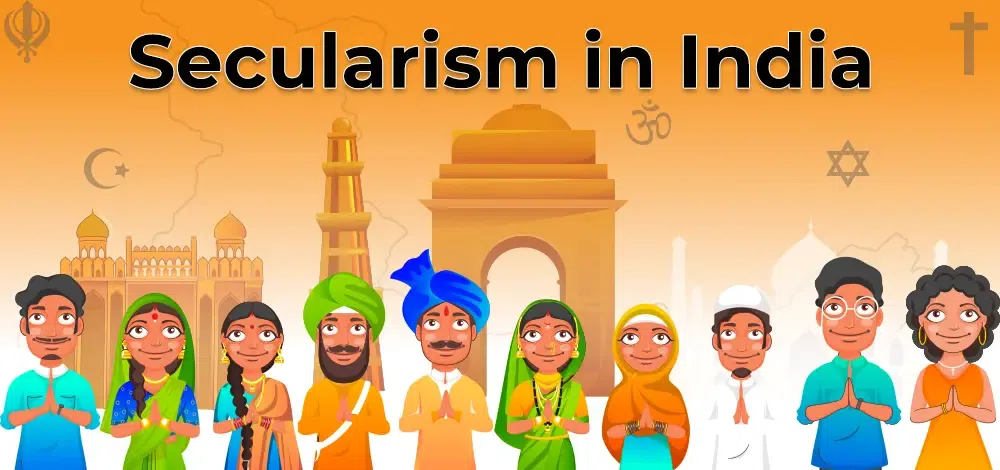
Secularism is the principle that the state does not favour any particular religion and treats all faiths equally, while allowing individuals the freedom to practice and propagate their beliefs. In India, secularism has a distinctive character because the country is home to multiple major religions and hundreds of smaller faith traditions. The Constitution guarantees freedom of religion and prohibits discrimination on religious grounds, and the word “secular” was explicitly added to the Preamble in the 1970s to emphasise this commitment.
Unlike some Western models that stress a strict separation between state and religion, India follows a “principled distance” approach. The state may engage with religious institutions—for example, to manage public order, regulate public religious endowments, or support minority educational institutions—while maintaining that no religion is the official religion of the state. Courts have affirmed secularism as a basic feature of the constitutional structure, meaning it cannot be easily altered. In everyday life, secularism matters because it underpins equal citizenship: laws, public services and political rights are supposed to apply to everyone irrespective of their faith, which is essential in a diverse society.






Leave a Reply